Showing posts with label Hurricane. Show all posts

Tuesday, December 29, 2020

My Red Cross Story: Miss Virginia 2020, Katelyn Page

Katelyn Page, Miss Virginia 2020
Written by: Clarice Nassif Ransom, Communications Volunteer

Volunteer: Katelyn O. Page, Miss Virginia 2020
Resides: Prince William County, Virginia
Years of volunteer service: Ongoing since the age of 16

Highlights of American Red Cross Volunteer Work: 

  • Ongoing blood donor; hosted an American Red Cross blood drive as Miss Virginia 2020
  • Deployed as a Shelter Associate during Hurricane Laura
  • Deployed as a Disaster Cycle Services Caseworker for Hurricane Laura recovery
  • Served as the American Red Cross Ambassador and Miss Virginia 2020 at the Annual Charity Golf Classic Fundraiser at the Robert Trent Jones Golf 
  • Served as a volunteer at U.S. Capitol in Washington, D.C., for Justice Ruth Bader Ginsburg’s Lying in State

_________________________________________________________________________

"My best advice is that you will never have enough time to do everything on your plate. However, if it is important to you, you will make time. 


Volunteering is everything, and you always get back more than you give."

_________________________________________________________________________

Meet Katelyn O. Page, Miss Virginia 2020, and an avid American Red Cross volunteer. Katelyn began her journey volunteering with the American Red Cross when she was 16-years old.

“I have donated with the American Red Cross since I was just 16-years old through blood donations,” said Katelyn. 

“Once I knew the impact that my O- blood type could make for others, I knew that I had to continue donating and encouraging others to join me.”

Kaitlyn is a regular O- blood donor. Only 7% of the population have O- blood.
Due to the versatility for transfusions, it is in high demand, but one of the rarest
 blood type's and  first supply to run out during a shortage.


Through donating blood, Katelyn feels she has helped save lives.

“Per the American Red Cross, just one blood donation can save up to three lives,” said Katelyn. 

“Something beautiful is that the American Red Cross has let me know some of the hospitals where my blood has gone to. That is the most tangible way that I know I have helped save a life.”

Katelyn continues helping others in need by volunteering wherever disasters occur. 

“The American Red Cross goes where the need is, during times of both calm and disaster,” said Katelyn.

“The American Red Cross ensures that various aspects of public health and disaster are addressed.”

When the COVID-19 pandemic struck, Katelyn rolled-up her sleeves and became a more active American Red Cross volunteer.

“At the beginning of the COVID-19 pandemic, I knew that I had to support the American Red Cross in any way that I could,” said Katelyn. “The COVID-19 pandemic inspired me to take a more active role. As such, I serve as a Disaster Cycle Services Caseworker, which allows me the opportunity to support others during their greatest time of need.”

Katelyn has also been deployed as an American Red Cross volunteer nationally, serving on the frontlines helping others to recover in the aftermath of Hurricane Laura, a destructive Category 4 hurricane that slammed Louisiana in late August 2020, causing loss of life and devastation of property. Katelyn worked in an American Red Cross shelter and was able to build strong connections with the people she served, helping to celebrate birthdays, anniversaries, and even the birth of a baby born during Hurricane Laura.

Katelyn deployed multiples times in support of Hurricane Laura
during this historical and devastating hurricane season.
“One connection that I will always cherish is a family whose child was born during the hurricane,” said Katelyn. “The family was heartbroken to not have a home to bring their baby to, but they explained that the American Red Cross made the shelter feel like home. During that time, we truly saw that home is where your loved ones are, it is not a building nor space.”

Katelyn (second from the right) in Lousiana with some fellow
volunteers supporting those affected by Hurricane Laura.
Katelyn encourages everyone to volunteer. 

“My best advice is that you will never have enough time to do everything on your plate,” said Katelyn. 

“However, if it is important to you, you will make time. Volunteering is everything, and you always get back more than you give.”

Katelyn devotes her reign as Miss Virginia 2020 to volunteering.

_________________________________________________________________________


“Serving as Miss Virginia 2020 has provided me with the opportunity to inspire other young people to do hard things, and to strive to reach a goal that they may have previously thought unattainable.” 

_________________________________________________________________________


Katelyn served as the American Red Cross Ambassador and
Miss Virginia 2020 at the Annual Charity Golf Classic.

“I have dedicated my reign to promoting child advocacy and advocacy in young people. It is my hope that young people will become advocates themselves. The American Red Cross has helped me to do this work.”

- - - - - - - - - - - - - - - - - - - - - - - - - - - - - - - - - - - - - - - - - - - - - - - - - -

You can join us too! 
To become a volunteer, visit redcross.org/volunteer.
To make a financial donation, visit redcross.org.
To make an appointment to donate blood, visit redcrossblood.org 

Friday, June 14, 2019

My Red Cross Story: Jackie Rivera

By Clarice Nassif Ransom, Volunteer

Volunteer: Jackie Rivera
Years of American Red Cross Volunteer Service: 2 years and counting (plus as a military spouse and in high school)
Resides: Aldie, Virginia
Profession: Accountant, retired; military spouse; mom
Advice: “I think my best advice is that if you want to help others, you have to let go of some of the things happening in your own life, not dwell on what is bothering you in your life, but to be there for others who are experiencing the worst time and help them respond and make it through to the next day.”


Public service has always been a part of Jackie Rivera’s life. As a child, Jackie grew up in a military family – her father was in the Army, as was her grandfather – and Jackie saw firsthand the importance of serving others. Jackie started volunteering for the American Red Cross as a lifeguard when she was in high school. Jackie’s next volunteer stint with the American Red Cross was as a military spouse with two children – she became the American Red Cross chapter chairman in Izmir, Turkey, managing a swimming pool on the military base where her husband served as an officer. Now, a retiree, Jackie is once again volunteering for the American Red Cross doing what she loves the most in life – helping people.

“I think if you have the capability and the capacity to help someone else you should,” said Jackie.

“I have instilled this belief in my daughters. We have a cute family story. When my youngest daughter Kathryn was taking a lifeguard class in Izmir, Turkey, my oldest daughter was the instructor, and I was American Red Cross chairman managing the swimming pool on base. When we came back to the United States, people had a hard time accepting Kathryn’s lifeguard training because the certificate was signed by Margarot Rivera, instructor, and Jackie Rivera, American Red Cross chairman – all with the same last name. Now, Kathryn is a police officer, and her job is to help people and to put away the bad guys, which is also helping people. Margarot has been an American Red Cross volunteer for more than 20 years. She is a CPR instructor, lifeguard instructor, and water safety instructor.”

Jackie, who rejoined the American Red Cross volunteer ranks two years ago, responds to local fires in the Washington, D.C., Maryland, and Virginia area as part of the American Red Cross Disaster Action Team (DAT). Jackie is on call 24/7, and when needed, which can be anytime day or night, drives to the location of the fire to help those affected. Jackie’s job is to talk to the those affected, keep them calm, and provide resources such as a cash card so their immediate needs can be addressed – which can include finding a place to sleep at a hotel the next night, being able to go to the grocery store for food, and buy clothing or shoes.

“Most of the time, people escape a fire with just the clothes on their backs and nothing else, and the American Red Cross is a safety net to help them make it through the day,” said Jackie. “I like helping people make it through their worst time.” Jackie recently helped organize one of the American Red Cross’ Sound the Alarm events, which was aimed at installing 100,000 smoke detectors in one month this Spring in people’s homes nationwide, especially the elderly and other at-risk communities.

Jackie also deploys to locations nationwide to help respond to disasters such as floods and wildfires, delivering supplies to victims and working in American Red Cross shelters established to help displaced people.

“My first out-of-state deployment was with the American Red Cross logistics’ team in Kentucky, where we went out in large trucks and distributed supplies for people to use to clean up after the floods,” said Jackie.

“We delivered a clean-up kit that included a broom, mop, shovel, rake, Clorox, and rubber gloves. We gave out meals ready to eat (MREs) and cases of water. I interacted directly with those affected, and it jerked at my heart. We met some really sweet people who had something tragic happen to them, and the American Red Cross was there to help.”

Jackie also deployed to Wilmington, North Carolina, after the hurricane in the fall of 2018. On this trip, Jackie helped deliver supplies such as water, food, snack bars, and MRE’s to bulk distribution points, such as fire stations and churches. While she did not get as much direct interaction with individual clients, Jackie saw the positive impact the American Red Cross made on many in the community who were devastated by the hurricane. Jackie also served as an American Red Cross shelter volunteer leader during Thanksgiving, and then again at Christmas, in Chico, California. At that time, the wildfires, sparked by a campfire (the California Campfire) ripped through the community, destroying property and lives in its path. Jackie said she became close to the shelter residents during her Thanksgiving trip, and when she came home, she worried about them.

“I became like a dorm mom to the shelter residents,” said Jackie, who said the Thanksgiving deployment was for a two-week stint.

“People came to me to help solve problems. One elderly gentleman had cold feet, so I was able to provide him with socks. Many times, I became the person who would listen, and that helped the shelter residents. I became close to the residents, so when I went home, I really worried about them.”

When the American Red Cross asked for volunteers to go to the California Campfire during Christmas, Jackie was inspired to return, but this time to a larger shelter helping displaced men, women, and children. Many of the residents Jackie helped in Chico are on the road to rebounding. Jackie was thrilled to receive a letter from one of the residents expressing appreciation for the American Red Cross and thanking Jackie personally for all her hard work and making everyone feel someone cared, and was there for them, during a devastating time in life.  

When Jackie is not responding to fires or being deployed to help with a disaster, she is volunteering at large events for the American Red Cross, like Rolling Thunder in Washington, D.C. over Memorial Day weekend. Jackie helped provide food, water, and cooling tent shelters to emergency responders and the thousands of bikers who came to Washington, D.C., to memorialize military friends, family members, and strangers who gave their lives in service to others.

“I was in awe of the thousands of bikers who came from around the nation to pay respect to their loved ones and people they didn’t know who served in the military so we could keep our freedom and way of life,” said Jackie.

“One biker told me he came annually to Rolling Thunder. It was his 25th year to ride and remember his colleagues and friends who died in Vietnam. It really touched my heart. The roar of the motorcycles, sounding off in unison for our fallen soldiers, is an amazing experience and one I will never forget.”

Even when Jackie is not on official American Red Cross volunteer duty, she is devoted to helping others. Recently, Jackie had picked up an American Red Cross utility truck and was headed home – she needed the truck for the next morning to deliver supplies to an event. As Jackie was passing routes 66 and 28 in Centreville, Virginia, she saw one car stopped on the side of the road, several motorcycles, and some road crew workers. Jackie could also tell someone was laying on the ground. Jackie knew she had to stop.

“I heard someone say, ‘Oh, the American Red Cross is here, and it is going to be ok,” said Jackie. “It was the witness who was on the phone with the 9-1-1 dispatcher. The dispatcher told the witness to get a clean cloth and apply pressure to the victim’s wound to stop the bleeding until the emergency responders arrived.”

The witness gave a clean towel to Jackie who went to the victim laying on the ground. Jackie observed the victim had a large gash on the right side of the victim’s chest and was bleeding.

“I started to apply pressure and tried to keep the victim calm and awake by asking her questions such as what happened, and are you hurt anywhere else?” said Jackie.

“She kept trying to go to sleep, and I needed to keep her awake. The next thing I knew, the emergency responders were there and tapped me on the shoulder and told me to keep applying pressure to the victim’s wound while the emergency responders put a neck brace on her and strapped her down to a board. Then I was allowed to remove my hand from the wound, and the emergency responders took over. The victim and her friend had been riding motorcycles when a car side-swiped the victim and drove off – a hit and run. The fellow motorcycle rider was not injured, but was in shock.”

After the emergency responders began to treat the victim, Jackie knew the victim’s friend also needed encouragement, so she hugged the friend and then hugged the person who called 9-1-1. Jackie said one of the road crew workers asked for a hug too.

“The American Red Cross gives away all the hugs you need,” Jackie said she told the road crew worker and then gave him a hug. Although Jackie does not know the final outcome of the situation, she was thankful she was there to help.

“Something that inspires me to keep volunteering is being around other American Red Cross volunteers,” said Jackie. “There are so many great people who volunteer for the American Red Cross. Volunteering brings out the best in people – from all walks of life. They just want to help someone else, and they give of their time to help others and that keeps me going too.”


Wednesday, June 5, 2019

Hurricane Season Preparedness

By Carly Flumer, Volunteer

The start of summer can mean a huge splash of wet weather for us on the east coast. Hurricane season officially started on June 1st, and the Red Cross wants to make sure that you’re prepared.


First, know the difference between a hurricane warning and a hurricane watch and what you should do in each case:

Hurricane warning: 

  • Hurricane conditions are expected somewhere within the specified coastal area within 36 hours
  • Secure all windows with shutters with plywood
  • Place all valuables, including important documents, in a waterproof container and place in the highest floor of your home

Hurricane watch: 

  • Hurricane conditions are expected somewhere within the specified coastal area.
  • The warning is issued 36 hours in advance of the anticipated onset of winds of a hurricane force


  • The National Weather Service will issue what’s called an “Extreme Wind Warning” when sustained surface winds of 115 mph or stronger are occurring or are expected to occur within one hour as a result of a Category 3-5 hurricane


    1. Fill your vehicle with gas
    2. Bring in loose objects from outside
    3. Secure all doors on your property
    4. Move your car to a garage or other secure location
    5. Prepare to evaluate when ordered

Other tips to be prepared and provide safety to you and your loved ones:

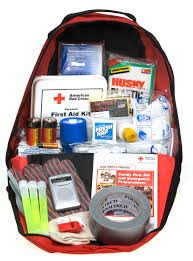
  • Create a kit that has a hand-cranked radio to keep track of the storm, a flashlight with extra batteries, first aid, and extra cash
  • Practice evacuating with your family: have a plan and make sure everyone knows where to go, including if you live in a hurricane evacuation area, and where supplies are kept
  • Download the Red Cross Emergency App to stay updated on the latest emergency alerts


Sources:
https://www.weather.gov/safety/hurricane
https://weather.com/safety/hurricane/news/hurricanes-safety-during-20120330
www.redcross.org

Tuesday, November 6, 2018

My Red Cross Story: Joe Rollo

Written by: Rosalind SE Carney, Volunteer

Over a year later, Joe Rollo recalls his Hurricane Harvey disaster relief experience.

Joe Rollo has been a volunteer with the American Red Cross since he retired in 2015. As the former Director for Psychological Services in the Prince George’s County, MD, Police Department, he has extensive experience in emergency response and mental health counseling services. Joe’s primary interest with the Red Cross is volunteering with the Reconnection Workshops that help service members reintegrate into the family dynamic when they return from deployment.

Joe is also trained in disaster relief and deployed to Houston, Texas, during Hurricane Harvey in 2017. Given his background, his role as a volunteer in Houston was to provide psychological support to those affected by Hurricane Harvey, and provide emotional support to other Red Cross volunteers.

In September 2017, Joe arrived at the George Brown Convention Center in Houston, a city where his son and wife’s family lives. For the next ten days, Joe saw the exemplary work of the Houston Police Department, especially considering one of their officers had died as a result of his hurricane relief efforts.

3rd from the right: Joe Rollo
Joe describes how many of the people who sought refuge at the Convention Center shelter were not displaced from their homes – they were homeless. He noted that people in the shelter were remarkably cooperative despite the challenging conditions; there was a sense of appreciation between people. The children who were displaced from their homes or who were homeless were particularly resilient. In fact, the children seemed more adaptable than their parents, perhaps as they did not fully grasp the gravity of the situation.

Out of those unfortunate conditions, some positive events occurred.

Many homeless people were veterans, including a group of six Vietnam veterans. While under the care of the Red Cross, homeless people received regular meals and medical checkups they would otherwise not have had. Importantly, the veterans received information regarding specific Red Cross services available to them of which they were unaware. Two of the homeless Vietnam veterans reconnected with their children, who had been displaced from their homes by Hurricane Harvey.

A number of National Guard members who helped at the Center had previously been deployed to Iran and Afghanistan. A fraternity developed between the veterans and the younger members of the military. A spirit of working together also formed between the Red Cross volunteers, the Southern Baptists who provided food, and an Islamic group that works nationally with flood victims.

From the experience in Houston, Joe gained an increased sense of trust, compassion, and gratitude. He had lost colleagues in both the law enforcement and the military, and the Red Cross has helped him to find another family.


Friday, June 29, 2018

Hurricane Safety 101

By Hailie Duenkel, Volunteer  

Hurrican Season began on June 1st, meaning the Atlantic Coast will be susceptible to hurricanes producing deadly storms, floods, tornadoes, and high winds. Each year the methods for hurricane safety improve, however it is still imperative to remain current and attentive as the summer months approach. Below are some guidelines from the American Red Cross so you and your loved ones are equipped for this upcoming season of storms.

NOAA/Reuters
Tips to prepare:
          Adrees Latif/Reuters
During a hurricane:
  • Remain indoors and as far away from flood waters as possible. 
    • DO NOT ENTER WATER! (As little as 6 inches of water can float a moving vehicle.) 
  • Do not remain in your vehicle if you are caught unexpectedly in a storm while driving. Quickly exit and get to higher ground. 
  • Replace candles with flashlights – This prevents winds and debris knocking over candles and potentially starting house fires. 
Alvin Baez/Reuters
After a hurricane:
  • Stay in tune with evacuation alerts, local weather forecasts, and friends and family on your wellbeing. 
  • Use only bottled water until you are alerted that the water in your house is not contaminated.
  • Stay clear of any lose power lines and report them immediately to your local power company. 
Erik S. Lesser/EPA
Hurricanes are one of Mother Nature’s deadliest natural disasters. However, the safety precautions you make can greatly diminish their destruction and save lives. For more information on hurricane safety, please go to the Red Cross website hurricane safety page.  

Thursday, June 21, 2018

My Red Cross Volunteer Story: Jane Callen


By Rose Ellen O'Connor, Volunteer

Hurricane Katrina struck the Gulf Coast with deadly force in August 2005 and Jane Callen watched the news accounts with horror. Thousands of people were stranded, injured and dying and pleading for help. Bodies were floating in the streets. Jane felt compelled to act. She took a three-week leave of absence from her job as the Economic Information Officer for the U.S. Department of Commerce and went to the Gulf Coast with the Red Cross.

Jane volunteering as part of the
 relief efforts for Hurricane Katrina.
“Seeing those images, how could one not have been moved to help?” Jane asks.

Since then, Jane, named Montgomery County, Maryland’s volunteer of the year in April, has served in countless ways. She’s climbed a mountain in Nepal to help victims of an earthquake and reached out to survivors of hurricanes in Florida and the U.S. Virgin Islands. Here at home, she volunteers as an Emergency Medical Technician (EMT) and the EMS Lieutenant with the Glen Echo Fire Department, is a member of the Red Cross Disaster Action Team, and sits with the dying in hospice care.

The desire to help is a glue that binds volunteers, Jane says.

At first, those who came to help after Hurricane Katrina struck seemed to have little in common and were a bit standoffish. As a woman working atop a truck hoisting heavy loads of water, ice and other supplies, dripping with sweat, days without a shower, hair wild, she caught some second looks. But within a week, differences such as background, politics, and education fell away. They were united by a shared commitment to help.

After a long, hot day, looking for survivors, they would return to their base, collapse into flimsy camping chairs, and each throw back a Bud Light. Then they would forage for food, opening up a can of whatever they could find. Jane’s a vegetarian, so finding food could be challenging. Her fellow volunteers would tease her, asking if she wanted cans containing beans flavored with bacon. Then they would head to their bedroll and go to sleep on a concrete floor.

Together, they saw many gut-wrenching scenes. There were the poor neighborhoods where people were already living on the edge before the hurricane and now were desperate, their basic needs not being met.

“Part of what made it possible to continue was we were there for each other,” Jane says. “We stayed in touch long after that trip.”

Jane volunteering as part of the
relief efforts for Hurricane Katrina.

In April 2015, Jane went to Nepal for two weeks after a devastating earthquake. Her team of four spent a day climbing a grueling mountain path to reach a village in need. They made it to the top and a huge earthquake – magnitude 7.3 – struck not far away. Buildings collapsed around them and the path they had taken was buried by dirt and boulders. They treated the most badly injured late into the night. It was an enormous challenge getting the most seriously injured off the mountain. Villages and volunteers worked together to build a fire of rags in hopes that a helicopter would spot them. An Army chopper saw the flames and came.

Late that night, the team tried to get word to their families back home that they were okay. Aftershocks were coming every few minutes. They crawled on their hands and knees around the mountain top, waving their phones in the air, trying to find a signal. No luck. Jane felt physical pain thinking what her family must be going through.

Around 4 a.m., Jane awoke to dozens of tiny hands on her tent. Village children were peering in to see who was there. Many of the children needed attention for injuries and conditions unrelated to the earthquake because they didn’t have access to proper medical care. The volunteers got up and tended to the children’s medical needs as best they could. All the while, Jane could not stop worrying about what her family might be thinking. Later that morning, a man arrived who had fallen off a motorbike while ascending the mountain during the second earthquake. He had a cell phone and the volunteers were thrilled when they realized it worked. Jane called her husband.

“The fact that I was alive and standing there on that mountain bathed in sunshine, hearing my husband’s voice – it was a brilliant, shining moment,” Jane says.

Jane’s memories of Nepal are flooded with the images of families standing in front of piles of total wreckage that once had been their homes. They were smiling. In the midst of disaster, they appeared happy and grateful to be alive. They welcomed the volunteers as their friends.

“The radiance of the Nepalese,” Jane says, “is beyond even the reach of an earthquake.”

Jane volunteering in Nepal for the devastating earthquake.
In September 2017, Jane deployed to Jacksonville, Florida and Charlotte Amalie, St. Thomas, in the U.S. Virgin Islands, to help victims of Hurricane Irma. It was still raining in St. Thomas and trees and twisted power lines littered the streets. The island had no power.

In Jacksonville, the storm surge had not receded entirely days after the storm. The volunteers went to visit an elderly couple who had shuttered themselves into their home. They both were in declining health, and the home had been in the family for decades. The couple was determined not to be uprooted. Mold had begun growing on the walls and the scene was heartbreaking, Jane says. They respected the couple’s wish to stay. The two had lost so much and Jane didn’t want them to lose their dignity. The volunteers opened doors and windows, set up a dehumidifier and some fans to get fresh air moving. They made sure the couple had plenty of drinking water and knew who to call for help.

As is too often the case with disasters, there can be so much sadness that sometimes it is difficult to know what to say. After Hurricane Irma, a woman came in to get her vital signs checked. It turned out she and her family had lost their home when Hurricane Harvey struck Texas a month earlier. Then the temporary housing they had found in Florida was wiped out by Hurricane Irma. She and her husband and two children had been living in their car when social services took their children away. In the midst of all of this, she had a stroke. Jane convinced her to go to the hospital and the volunteers also guided her to the Federal Emergency Management Agency and local social services for assistance finding her children.

But there was also joy in the smallest of things. Jane recalls an elderly woman in a shelter in St. Thomas. The woman was blind, unable to walk, and terminally ill. She’d been in hospice care before the hurricane, but shelter workers couldn’t reach the hospice so she was not receiving any pain medication. But she never complained. One day she told Jane she’d really like some strawberry-vanilla ice cream. Here they were, in the middle of an island in blazing heat without power. But it was the one thing she’d asked for. Jane found a car and driver and they negotiated the debris, moving at a crawl to the only open grocery store. Most of the shelves were empty but unbelievably there in the freezer was one quart of strawberry-vanilla ice cream. They inched slowly back to the shelter through snarled traffic and brutal heat and somehow the ice cream didn’t melt. Jane joyfully handed it to the woman.

Jane volunteering in Nepal for the devastating earthquake.
“Her face opened into the most magnificent smile as she felt the cold container in her hand and seconds later tasted the ice cream,” Jane recalls. “It was magic.”

Here at home, Jane deploys most Monday nights as an EMT and EMS Lieutenant with the Glen Echo Fire Department. A fair number of calls are for cardiac emergencies. Administering CPR is hard and scary, although training tempers the fear. As a crew, everyone is working together like mad trying to revive the patient. It’s exhausting, physically and emotionally. But on those occasions when you are able to bring someone back after a heart attack? It’s beyond amazing, she says.

Jane helped develop the Advanced Life Support (ALS) program at the Glen Echo Fire Department. ALS provides a higher level of pre-hospital care for the most severe medical emergencies, such as unconscious patients and cardiac events. It requires a vehicle equipped with more sophisticated and expensive technology, such as a 12-lead cardiac monitor. Jane and the fire chief met with Montgomery County officials and proposed a pilot program. Their station would raise the money to pay for the equipment and train volunteers to staff the vehicle. After six months, the pilot was declared a success and became permanent.

At least once a week, Jane volunteers at the JSSA (Jewish Social Service Agency) hospice. She also visits two people who were diagnosed with six months or less to live several years ago. They left the hospice program, but she continues to visit them.

Jane often brings her Yorkie, Callie, with her. Callie went through the PAL (People Animals Love) certification program and is trained for hospice care. Patients love Callie: she’s eight pounds of affection. She will crawl right into bed with someone, lie against them, cuddle and lick them, Jane says.
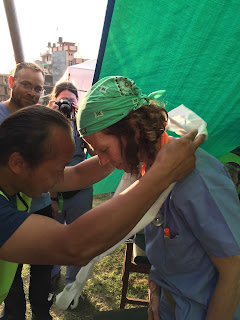
Jane volunteering in Nepal for
the devastating earthquake.
Jane also brings along a body tambura, a musical instrument developed in India to help alleviate the pain of patients in hospices that can’t afford pain medication. The instrument is placed on the person’s body. A study at St. Joseph’s Hospice for Dying Destitute/South India found the patient’s pain was cut in half after a relatively brief exposure and cut in half again the next day. Jane contacted the study’s author and found she could get a body tambura in Germany -- and had one made.

Jane’s interest in hospice care was sparked by the extremely different experiences of her father and mother at the end of life. Her father died in 2002 after a drawn-out battle with colon cancer. Jane recalls the hospice caregivers that came to her parents’ home lecturing her father about dying instead of listening to what he had to say. It broke him and all of the family, she says.

Ten years later, her mother came to live – and die – in Jane and her husband’s home. Her mother’s doctor, who was associated with the JSSA, made house calls and guided them through the hospice process with kindness and understanding – as well as enormous competence.

“After that experience, which I would characterize as a good – even healing – death, I became an evangelist for dying well,” Jane says. “The hospice team can make all the difference.”

Jane’s mother took her final breath within seconds of the earthquake that struck Maryland in August 2011. Jane’s son had just moved back from California and had the presence of mind to tell everyone to get to a doorway. A little while later, Jane and a few close women friends and family gently washed her mother’s body, all the while singing to her. As Jane sat by her mother, more friends began showing up with fresh flowers and herbs from their gardens and they lay them on and around her mother’s body. Some friends played music. After the sun set, it seemed the right time to bring her mother’s body out and as they emerged they found people with candles lining the path from house to street.

“That set the tone for my work in hospice, really,” Jane says.  “The possibility of a beautiful experience around death.”

Jane is one of 11 master trainers for Maryland Medical Orders for Life Sustaining Treatment. MOLST is a document that captures people’s end of life wishes. It goes way beyond its predecessor, the Do Not Resuscitate Order. It captures a patients’ wishes for a host of treatments, such as whether they want feeding tubes to be put in or to be transported to a hospital.  Jane and the other master trainers travel around the state educating health professionals, assisted living facilities, and the public in how to use the MOLST form.

Jane was named Montgomery County, Maryland’s
Volunteer of the Month earlier this Spring.

Jane, 57, has two masters degrees: one in social work and the other in government. She is the senior editor and writer at the U.S. Census Bureau. She lives in Bethesda, MD with her husband, Harry Lewis, and their two Yorkies, Callie and Cruiser. Her one adult son is engaged and Jane says she’s looking forward to grandchildren.

The third of four sisters, Jane says her parents chose to settle in Chevy Chase because they believed the Washington area was ground zero for civil and human rights volunteer work. Jane’s father, Dr. Earl Callen, a college physics professor and department chair at American University, started the American Civil Liberties Union of the National Capital Area. He was also on the Helsinki Watch Committee, whose mission was to monitor the former Soviet Union’s compliance with the Helsinki Accords, agreements to accept the post-World War II status quo in Europe.

Jane Callen
He regularly traveled back and forth to the Soviet Union to try to help “Refusniks,” -- scientists being persecuted and prevented from leaving. Dr. Callen frequently testified before Congress on this and other issues. He also was an outspoken anti-war activist and was frequently interviewed because, as a physicist, he could provide unique insight into nuclear war.

Jane’s mother, Anita Callen, was a stay-at-home mom and her quiet presence was the yin to her father’s yang, Jane says.

Jane recalls bouncing on her father’s shoulders amidst a sea of people as they headed toward the Lincoln Memorial, joining Martin Luther King Jr.’s March on Washington. It was her father’s 39th birthday – August 28, 1963. She knew they were among a minority of white people and that it was important to be there, to stand up for civil rights. It was one more lesson on the importance of taking action, a father-to-daughter message that has shaped her life.

“That was such an important lesson, taking action not for self-gain but for a greater good – without regard to personal risk,” Jane says. “Throughout his life, my father demonstrated the importance of always showing up.”
Friday, June 1, 2018

Hurricane Season Safety - Be Red Cross Ready

Written by Carly Flumer, Volunteer

June marks the beginning of Hurricane Season, and it’s important to be Red Cross Ready no matter what coast you live on. 


This means:
  • Assembling an emergency preparedness kit, consisting of water, non-perishable food, a flashlight, as battery-powered or hand-cranked radio, extra batteries, a first aid kit and any medications, sanitation and hygiene items, cell phones with chargers, and personal documents that include important contact information
  • Creating a household evacuation plan that determines how to prepare and respond in case of an emergency, including the various responsibilities of each family member. Don’t forget your pets!
  • Staying up-to-date on your community’s response plan
  • Educating yourself and family members on how to use the Safe and Well website, which includes information about getting immediate assistance and contacting loved ones
  • Downloading the Emergency App for iPhone or Android
 Additionally, right before a hurricane occurs, protect your family, pets, and home by:
  • Finding an NOAA radio station in your area
  • Keeping all personal documents and valuables in a lock-safe box
  • Assemble an emergency kit for your pet that includes sturdy leashes or carriers, food, drinking water, medications, and current photos of them in case they get lost
  • Protecting windows with storm shutters
  • Identifying a place to store any lawn furniture, tools, and trash cans to prevent them from being tossed by extreme winds
  • Clear clogged rain gutters to prevent flooding and pressure on the awnings
  • REMEMBER: Standard homeowners insurance doesn’t cover flooding, but flood insurance does.

Hurricane Season starts on June 1 and runs until November 30. For more information on hurricane safety, visit: http://www.redcross.org/get-help/how-to-prepare-for-emergencies/types-of-emergencies/hurricane 


Tuesday, May 29, 2018

My Red Cross Disaster Volunteer Story: Herb Brennen

Pictured: Herb Brennen (Right) and Don Brauninger (Left)
Written by: Rose Ellen O’Connor, volunteer 

Herb Brennen felt a deep emptiness when his wife Susan died of breast cancer 20 years ago. Then he gave up his job as a budget administrator at Lockheed Martin in an early buyout and he had unexpected time on his hands, which only heightened his loneliness. He was looking for things to do and saw an ad for the Red Cross. 

“It was after she had passed away that I got into the Red Cross,” Herb says. “Her death left a big hole in my life and I was looking for things to fill it.”

Herb was quickly hooked on the Red Cross. In 2002, he deployed to Louisiana for Hurricane Lili, the second most destructive hurricane of that year. Since then, he’s been on a dozen deployments to all sorts of disasters from wildfires and mudslides in California, to tornados in North Carolina and Tennessee, to hurricanes in New York and Florida. His shortest deployment lasted several days; his longest was two and a half months in Houston for Hurricane Katrina. That devastating hurricane struck the Gulf Coast in August 2005, packing winds of up to 175 miles an hour. It killed 1,836 people and resulted in $81 billion in damage. An estimated 1.5 million people were evacuated and tens of thousands fled to shelter in Houston.

Herb’s task on deployment is to arrange short-term financial assistance for disaster victims. Sometimes he’s removed from one-on-one contact. In Houston, he oversaw 400 people inputting data to set up financial assistance for hurricane victims and didn’t interact with them. Other times, he deals directly with the hurricane survivors. He sees a lot of desperation and is rewarded by being able to help.

“When you’re in a situation where people are absolutely needy and you’re able to give them a credit card and they can then use that money to provide for their family, the look on their face tells it all,” Herb says. “Relief. And gratitude.”

Sometimes his volunteer work can be very emotional. Herb recalls a mother he helped in Chattanooga, TN. He was deployed there after heavy rains caused flooding and mudslides. She had an infant, two toddlers, and was fighting drug addiction. She became very emotional as she told her story to Herb and he couldn’t get her to stop crying, so he sent for a mental health expert to help her. After she calmed down, Herb began to tell her that he was arranging a hotel room for her and would give her a credit card so she could buy food for herself and the children and formula for the baby. She was so grateful, she grabbed his arms and thanked him and became very emotional again.

“She started to cry again and I got emotional,” Herb recalls. “And the three of us were sitting there, all of us practically crying.”

Herb says most of the hurricane clients used the financial aid to get out of the shelter. Some used the money to go back to their homes and wait for the Federal Emergency Management Agency (FEMA) to give them money to repair their houses, and others, having lost everything, used the money to move on.

In September 2004, Herb deployed to Fort Pierce, FL for Hurricane Frances. He remembers giving assistance to a mother of three small children who needed bus fare to get to family who could give them housing in another part of the state. In August, after Hurricane Harvey ravaged southeast Texas and southwest Louisiana, killing at least 88 people and doing $125 billion in damage, Herb deployed to Houston. Among those needing financial assistance was a homeless man looking for fare to another part of Texas where a friend was going to give him a job. In each case, the recipient of the assistance was, again, relieved. 

“Total relief,” Herb says. “Because they were broke and they had no way to get out of the shelter and they wanted to leave the shelter and the assistance gave them the means to do it.”

When Herb isn’t taking off for floods or hurricanes or wildfires, he works local disaster relief in Prince William County, VA. He responds to house fires about once or twice a month. Asked what drives him, his answer is simple.

“I think the same thing that drives anyone as a volunteer for Red Cross,” Herb says. “You volunteer because you see there’s a need and there’s something you can do about it. I think every Red Cross volunteer will tell you the same thing.”


Herb lives in Haymarket, VA. He has two children, Adina and Greg, and five grandchildren. Before working for Lockheed Martin, he worked for 27 years as a budget administrator for IBM.

Wednesday, December 13, 2017

The Devastation Caused By Hurricane Harvey Inspired Me To Help Others: Judith Ahanonu’s Story As A Red Cross Volunteer


Interviewed by: Rosalind SE Carney, volunteer
 
What motivated you join the Red Cross as a volunteer?
“I drove past the Red Cross building at the time when Hurricane Harvey hit Houston, Texas. I had seen on the news the devastation the people faced and I decided there and then to volunteer with the Red Cross.”
 
What recent volunteer work did you perform for the Red Cross?
“I volunteered with the finance department of the Red Cross. I became part of a team of four members known as the “gratitude gang.” The role of the gratitude gang was to thank people for recent donations ranging from $100 to $10,000. Donors who gave $5000-$9999 received a handwritten thank you note. Those who donated $1000-$4999 received a personalized thank you email, and the remaining donors were thanked by a phone call from a member of the gratitude gang.”
 
How was your experience as a Red Cross volunteer?
“It was a really rewarding experience, especially as this process of personally thanking donors was recently initiated with the creation of the gratitude gang. At the last count, my teammates (Christine Spalding, Lauren Waymire, Laura Song) and I had thanked over 28,000 donors. We also had the opportunity to interview by phone volunteer recruits who wanted to deploy to assist with hurricane relief efforts.”
 
Is there a particular anecdote of a phone call with a donor that you remember?
“Yes! A lady told me that she had volunteered with the Red Cross for twelve years. Her late husband had also been a volunteer and they had regularly donated money to the Red Cross when natural disasters occurred. The phone call from the gratitude gang was the first thank you call she had received. She was so touched that she promised to continue donating. She also encouraged us to keep up the good work! She said that the phone call was so fulfilling and that she really appreciated being recognized by the Red Cross.”
 
What did you perceive as the donors’ primary motivation?
“In general, compassion; people just wanted to help. Others just wanted to give back to society as a humanitarian response. Some of the donors had relatives and friend in the areas affected by Hurricane Harvey or Hurricane Irma.”
 
What future volunteer roles are you looking forward to with the Red Cross?
“I would really like to be deployed to relief shelters because it really makes you appreciate the little things in life. You have to have a heart larger than life itself to embark on such missions. I LOVE what the Red Cross stands for, I commend them for returning normality to communities daily, touching lives in many ways. It was really an eye-opening, rewarding and fulfilling experience for me to volunteer as a part of the gratitude gang. It is an honor to be granted this interview to inform others of my experience. Thank you.”


www.redcross.org/volunteer

Wednesday, November 8, 2017

Red Crosser delivers in Puerto Rico: “I wasn’t gonna let her down”

“I was in Patron, Morovis, Puerto Rico and this little old lady comes up to me and starts patting me on the chest and talking in Spanish,” remembers John Hendricks, a Red Cross volunteer from Detroit, Michigan serving in Puerto Rico for the Hurricane Maria relief effort. His voice is raspy from camping out in the mountains with his Red Cross team delivering water filters to the most remote communities, house by house. “I said to her, ‘I’m a gringo, I don’t speak Spanish,’ but I got one of my teammates to translate for me.” John’s eyes get misty. His translator said, “She is patting your chest because she saw you in the mountains and she loves your heart.”

John was touched by Rosa Maldonado Ortiz’s gesture and, with translation assistance, learned more about her situation. At 87 years old, she lost part of her house during the hurricane. Three of her grandchildren live upstairs in her home. Like most homes on the highlands of Puerto Rico, there is no running water and families collect water from mountain springs. Mrs. Ortiz happily accepted a high-volume Sawyer water filter, one of 13,000 (and counting!) units Red Cross volunteers have placed into the hands of the most isolated Puerto Ricans. The training she received on its use will help her keep her family safe from bacteria, viruses and toxins. However, she desperately needed tarps to keep out the seasonal downpours, she told John. He promised to return.
When John went to the closest Red Cross warehouse, all the tarps had been distributed and the next shipment had not yet arrived. “I wasn’t gonna let her down, so I went to Home Depot and bought her tarps,” John says in his matter-of-fact, Middle America style. “When I took her the tarps, she told me she needed a cat.” Mrs. Ortiz was worried about the increasing number of rats, mice and the diseases they might transmit to her grandchildren.
As it so happens, an abandoned kitten was rescued on a relief distribution in Juana Diaz during a thunderstorm. “We couldn’t leave the kitten there in a downpour, so we took it to a veterinarian,” said Leo Taraborrelli. “The vet estimated it was born about the time that Hurricane Irma came through.” When John told Leo about Mrs. Ortiz, he gladly offered up the rescued kitten to the cause. After all, as Red Cross volunteers, they have been working 15-hour days and are mostly away from their shelter. This way, the kitten would be in a home with children to love him.

Later that night, John and Leo made a special trip back to Patron, Morovis to Mrs. Ortiz’s home with the cat. “I’m so happy, thank you!” said Mrs. Ortiz. Red Cross responders, like John and Leo, continue their emergency relief efforts in Puerto Rico with a strong sense of urgency due to sustained damage to critical infrastructure like water and electricity. Red Cross teams continue distributing water filters in rural areas as a longer-term solution to the lack of access to clean water.

Click here for more Hurricane Maria Relief Information.