Showing posts with label deployment. Show all posts

Tuesday, December 29, 2020

My Red Cross Story: Miss Virginia 2020, Katelyn Page

Katelyn Page, Miss Virginia 2020
Written by: Clarice Nassif Ransom, Communications Volunteer

Volunteer: Katelyn O. Page, Miss Virginia 2020
Resides: Prince William County, Virginia
Years of volunteer service: Ongoing since the age of 16

Highlights of American Red Cross Volunteer Work: 

  • Ongoing blood donor; hosted an American Red Cross blood drive as Miss Virginia 2020
  • Deployed as a Shelter Associate during Hurricane Laura
  • Deployed as a Disaster Cycle Services Caseworker for Hurricane Laura recovery
  • Served as the American Red Cross Ambassador and Miss Virginia 2020 at the Annual Charity Golf Classic Fundraiser at the Robert Trent Jones Golf 
  • Served as a volunteer at U.S. Capitol in Washington, D.C., for Justice Ruth Bader Ginsburg’s Lying in State

_________________________________________________________________________

"My best advice is that you will never have enough time to do everything on your plate. However, if it is important to you, you will make time. 


Volunteering is everything, and you always get back more than you give."

_________________________________________________________________________

Meet Katelyn O. Page, Miss Virginia 2020, and an avid American Red Cross volunteer. Katelyn began her journey volunteering with the American Red Cross when she was 16-years old.

“I have donated with the American Red Cross since I was just 16-years old through blood donations,” said Katelyn. 

“Once I knew the impact that my O- blood type could make for others, I knew that I had to continue donating and encouraging others to join me.”

Kaitlyn is a regular O- blood donor. Only 7% of the population have O- blood.
Due to the versatility for transfusions, it is in high demand, but one of the rarest
 blood type's and  first supply to run out during a shortage.


Through donating blood, Katelyn feels she has helped save lives.

“Per the American Red Cross, just one blood donation can save up to three lives,” said Katelyn. 

“Something beautiful is that the American Red Cross has let me know some of the hospitals where my blood has gone to. That is the most tangible way that I know I have helped save a life.”

Katelyn continues helping others in need by volunteering wherever disasters occur. 

“The American Red Cross goes where the need is, during times of both calm and disaster,” said Katelyn.

“The American Red Cross ensures that various aspects of public health and disaster are addressed.”

When the COVID-19 pandemic struck, Katelyn rolled-up her sleeves and became a more active American Red Cross volunteer.

“At the beginning of the COVID-19 pandemic, I knew that I had to support the American Red Cross in any way that I could,” said Katelyn. “The COVID-19 pandemic inspired me to take a more active role. As such, I serve as a Disaster Cycle Services Caseworker, which allows me the opportunity to support others during their greatest time of need.”

Katelyn has also been deployed as an American Red Cross volunteer nationally, serving on the frontlines helping others to recover in the aftermath of Hurricane Laura, a destructive Category 4 hurricane that slammed Louisiana in late August 2020, causing loss of life and devastation of property. Katelyn worked in an American Red Cross shelter and was able to build strong connections with the people she served, helping to celebrate birthdays, anniversaries, and even the birth of a baby born during Hurricane Laura.

Katelyn deployed multiples times in support of Hurricane Laura
during this historical and devastating hurricane season.
“One connection that I will always cherish is a family whose child was born during the hurricane,” said Katelyn. “The family was heartbroken to not have a home to bring their baby to, but they explained that the American Red Cross made the shelter feel like home. During that time, we truly saw that home is where your loved ones are, it is not a building nor space.”

Katelyn (second from the right) in Lousiana with some fellow
volunteers supporting those affected by Hurricane Laura.
Katelyn encourages everyone to volunteer. 

“My best advice is that you will never have enough time to do everything on your plate,” said Katelyn. 

“However, if it is important to you, you will make time. Volunteering is everything, and you always get back more than you give.”

Katelyn devotes her reign as Miss Virginia 2020 to volunteering.

_________________________________________________________________________


“Serving as Miss Virginia 2020 has provided me with the opportunity to inspire other young people to do hard things, and to strive to reach a goal that they may have previously thought unattainable.” 

_________________________________________________________________________


Katelyn served as the American Red Cross Ambassador and
Miss Virginia 2020 at the Annual Charity Golf Classic.

“I have dedicated my reign to promoting child advocacy and advocacy in young people. It is my hope that young people will become advocates themselves. The American Red Cross has helped me to do this work.”

- - - - - - - - - - - - - - - - - - - - - - - - - - - - - - - - - - - - - - - - - - - - - - - - - -

You can join us too! 
To become a volunteer, visit redcross.org/volunteer.
To make a financial donation, visit redcross.org.
To make an appointment to donate blood, visit redcrossblood.org 

Wednesday, January 15, 2020

My Red Cross Volunteer Story: Shirley Gaines


Written by: Courtney Clarke, Communications Volunteer


Shirley Gaines has personal experience with
two lines of service at the American Red Cross.


Years of service: 3

Resides: Woodbridge, VA

Profession: Retired Medical Transcriptionist, Kaiser Permanente


Why do you believe in the work of the Red Cross?
Shirley and her family have had several personal experiences with the Red Cross, dating back over 50 years! They have been assisted by two lines of service within the Red Cross: Service to the Armed Forces and Disaster Services.

In the late 1960s, her brother was in the Army, stationed in Vietnam. The family would go long stretches of time without hearing from him, and they would worry about his safety. During one especially long period without contact from him, the family asked the Red Cross to track him down. The Red Cross was able to locate him and learn that he was recovering from malaria and was assigned to a clerical post in Vietnam. The family was relieved to learn that he was alive and well. 

Years later, Shirley’s mother’s home in Arlington, VA caught on fire. As the flames blazed, Shirley’s mother felt a sense of hopelessness and desperation. The Red Cross was instrumental in providing her mother, brother and sister with hotel accommodations until the soot that covered everything in their house was cleaned up and they received their homeowner’s insurance payment. Even more importantly than the financial assistance, the Red Cross restored her sense of calm and peace. Shirley doesn’t know what the family would have done without the Red Cross.

Based on her personal experience with the Red Cross, Shirley firmly believes in the organization and its mission. "You know where your money and resources are going when you donate to the Red Cross. I feel that the resources are going to the right place," she explains. Even for those who don’t have financial resources to donate, Shirley encourages people to donate blood, which is what she does. 
_________________________________________________________________

"I believe in the Red Cross and I give blood because they do a lot of good work.  This is my way of helping people - I don't always have cash to make financial donations, but I have blood and if i can give blood, that's something."
_________________________________________________________________

Why do you donate blood to the Red Cross?

Shirley is an Army veteran and has been active with the American Legion in the DC area for fifteen years. The Legion introduced her to donating blood around three years ago, when they had a blood drive on-site, and she has been donating quarterly ever since. This adds up to about 12 pints of blood, and each pint can save up to three lives!

With less than 38% of the U.S. population eligible to give blood, Shirley knows that her gift is an important one. Every two seconds, someone in the U.S. needs blood for surgeries, cancer treatment, chronic illness or traumatic injuries. “Donating blood is my way of helping to save lives,” Shirley boasts.

Donating blood is easy!
Donating blood is a simple process. First, go to redcrossblood.org to locate your nearest blood donation center and schedule an appointment. Then, to save time, click on the "RapidPass" link and complete your pre-reading and health history questions. When you arrive for your appointment, you'll be seated comfortably while a pint of blood is drawn; the actual donation only takes 8-10 minutes. After donating, you can enjoy a snack and a drink for 10-15 minutes before resuming your day. The entire donation process takes about an hour.

Click here to learn more about our Service to Armed Forces services. 

Click here to learn more about donating blood with the American Red Cross near you.

Friday, June 14, 2019

My Red Cross Story: Jackie Rivera

By Clarice Nassif Ransom, Volunteer

Volunteer: Jackie Rivera
Years of American Red Cross Volunteer Service: 2 years and counting (plus as a military spouse and in high school)
Resides: Aldie, Virginia
Profession: Accountant, retired; military spouse; mom
Advice: “I think my best advice is that if you want to help others, you have to let go of some of the things happening in your own life, not dwell on what is bothering you in your life, but to be there for others who are experiencing the worst time and help them respond and make it through to the next day.”


Public service has always been a part of Jackie Rivera’s life. As a child, Jackie grew up in a military family – her father was in the Army, as was her grandfather – and Jackie saw firsthand the importance of serving others. Jackie started volunteering for the American Red Cross as a lifeguard when she was in high school. Jackie’s next volunteer stint with the American Red Cross was as a military spouse with two children – she became the American Red Cross chapter chairman in Izmir, Turkey, managing a swimming pool on the military base where her husband served as an officer. Now, a retiree, Jackie is once again volunteering for the American Red Cross doing what she loves the most in life – helping people.

“I think if you have the capability and the capacity to help someone else you should,” said Jackie.

“I have instilled this belief in my daughters. We have a cute family story. When my youngest daughter Kathryn was taking a lifeguard class in Izmir, Turkey, my oldest daughter was the instructor, and I was American Red Cross chairman managing the swimming pool on base. When we came back to the United States, people had a hard time accepting Kathryn’s lifeguard training because the certificate was signed by Margarot Rivera, instructor, and Jackie Rivera, American Red Cross chairman – all with the same last name. Now, Kathryn is a police officer, and her job is to help people and to put away the bad guys, which is also helping people. Margarot has been an American Red Cross volunteer for more than 20 years. She is a CPR instructor, lifeguard instructor, and water safety instructor.”

Jackie, who rejoined the American Red Cross volunteer ranks two years ago, responds to local fires in the Washington, D.C., Maryland, and Virginia area as part of the American Red Cross Disaster Action Team (DAT). Jackie is on call 24/7, and when needed, which can be anytime day or night, drives to the location of the fire to help those affected. Jackie’s job is to talk to the those affected, keep them calm, and provide resources such as a cash card so their immediate needs can be addressed – which can include finding a place to sleep at a hotel the next night, being able to go to the grocery store for food, and buy clothing or shoes.

“Most of the time, people escape a fire with just the clothes on their backs and nothing else, and the American Red Cross is a safety net to help them make it through the day,” said Jackie. “I like helping people make it through their worst time.” Jackie recently helped organize one of the American Red Cross’ Sound the Alarm events, which was aimed at installing 100,000 smoke detectors in one month this Spring in people’s homes nationwide, especially the elderly and other at-risk communities.

Jackie also deploys to locations nationwide to help respond to disasters such as floods and wildfires, delivering supplies to victims and working in American Red Cross shelters established to help displaced people.

“My first out-of-state deployment was with the American Red Cross logistics’ team in Kentucky, where we went out in large trucks and distributed supplies for people to use to clean up after the floods,” said Jackie.

“We delivered a clean-up kit that included a broom, mop, shovel, rake, Clorox, and rubber gloves. We gave out meals ready to eat (MREs) and cases of water. I interacted directly with those affected, and it jerked at my heart. We met some really sweet people who had something tragic happen to them, and the American Red Cross was there to help.”

Jackie also deployed to Wilmington, North Carolina, after the hurricane in the fall of 2018. On this trip, Jackie helped deliver supplies such as water, food, snack bars, and MRE’s to bulk distribution points, such as fire stations and churches. While she did not get as much direct interaction with individual clients, Jackie saw the positive impact the American Red Cross made on many in the community who were devastated by the hurricane. Jackie also served as an American Red Cross shelter volunteer leader during Thanksgiving, and then again at Christmas, in Chico, California. At that time, the wildfires, sparked by a campfire (the California Campfire) ripped through the community, destroying property and lives in its path. Jackie said she became close to the shelter residents during her Thanksgiving trip, and when she came home, she worried about them.

“I became like a dorm mom to the shelter residents,” said Jackie, who said the Thanksgiving deployment was for a two-week stint.

“People came to me to help solve problems. One elderly gentleman had cold feet, so I was able to provide him with socks. Many times, I became the person who would listen, and that helped the shelter residents. I became close to the residents, so when I went home, I really worried about them.”

When the American Red Cross asked for volunteers to go to the California Campfire during Christmas, Jackie was inspired to return, but this time to a larger shelter helping displaced men, women, and children. Many of the residents Jackie helped in Chico are on the road to rebounding. Jackie was thrilled to receive a letter from one of the residents expressing appreciation for the American Red Cross and thanking Jackie personally for all her hard work and making everyone feel someone cared, and was there for them, during a devastating time in life.  

When Jackie is not responding to fires or being deployed to help with a disaster, she is volunteering at large events for the American Red Cross, like Rolling Thunder in Washington, D.C. over Memorial Day weekend. Jackie helped provide food, water, and cooling tent shelters to emergency responders and the thousands of bikers who came to Washington, D.C., to memorialize military friends, family members, and strangers who gave their lives in service to others.

“I was in awe of the thousands of bikers who came from around the nation to pay respect to their loved ones and people they didn’t know who served in the military so we could keep our freedom and way of life,” said Jackie.

“One biker told me he came annually to Rolling Thunder. It was his 25th year to ride and remember his colleagues and friends who died in Vietnam. It really touched my heart. The roar of the motorcycles, sounding off in unison for our fallen soldiers, is an amazing experience and one I will never forget.”

Even when Jackie is not on official American Red Cross volunteer duty, she is devoted to helping others. Recently, Jackie had picked up an American Red Cross utility truck and was headed home – she needed the truck for the next morning to deliver supplies to an event. As Jackie was passing routes 66 and 28 in Centreville, Virginia, she saw one car stopped on the side of the road, several motorcycles, and some road crew workers. Jackie could also tell someone was laying on the ground. Jackie knew she had to stop.

“I heard someone say, ‘Oh, the American Red Cross is here, and it is going to be ok,” said Jackie. “It was the witness who was on the phone with the 9-1-1 dispatcher. The dispatcher told the witness to get a clean cloth and apply pressure to the victim’s wound to stop the bleeding until the emergency responders arrived.”

The witness gave a clean towel to Jackie who went to the victim laying on the ground. Jackie observed the victim had a large gash on the right side of the victim’s chest and was bleeding.

“I started to apply pressure and tried to keep the victim calm and awake by asking her questions such as what happened, and are you hurt anywhere else?” said Jackie.

“She kept trying to go to sleep, and I needed to keep her awake. The next thing I knew, the emergency responders were there and tapped me on the shoulder and told me to keep applying pressure to the victim’s wound while the emergency responders put a neck brace on her and strapped her down to a board. Then I was allowed to remove my hand from the wound, and the emergency responders took over. The victim and her friend had been riding motorcycles when a car side-swiped the victim and drove off – a hit and run. The fellow motorcycle rider was not injured, but was in shock.”

After the emergency responders began to treat the victim, Jackie knew the victim’s friend also needed encouragement, so she hugged the friend and then hugged the person who called 9-1-1. Jackie said one of the road crew workers asked for a hug too.

“The American Red Cross gives away all the hugs you need,” Jackie said she told the road crew worker and then gave him a hug. Although Jackie does not know the final outcome of the situation, she was thankful she was there to help.

“Something that inspires me to keep volunteering is being around other American Red Cross volunteers,” said Jackie. “There are so many great people who volunteer for the American Red Cross. Volunteering brings out the best in people – from all walks of life. They just want to help someone else, and they give of their time to help others and that keeps me going too.”


Friday, May 17, 2019

Happy Armed Forces Day! 🎖️

By Carly Flumer, Volunteer

The Red Cross salutes our men and women of the Armed Forces today and every day, and especially on May 18th – Armed Forces Day. Many nations around the world observe some kind of Armed Forces Day to honor their military forces. It is celebrated in the United States as a day to appreciate all active duty service members. 


Armed Forces Day is celebrated on the third Saturday in May. This year, it is celebrated on Saturday, May 18. Thanks to President Harry S. Truman, it’s a day to pay special tribute to the men and women of the Armed Forces. President Truman led the effort to establish a holiday in order for citizens to unite and to honor our military heroes for their patriotic service in support of the United States. It also happens to coincide with this month being recognized as Military Appreciation Month.

The Service to the Armed Forces (SAF) program dates back to the establishment of the American Red Cross by Clara Barton in May 1881. Not only did the “Angel of the Battlefield” risk her life tending to soldiers wounded in the Civil War, she bolstered their morale by writing letters for them to send to their families. Today’s American Red Cross workers proudly carry on this tradition through the SAF program, which serves as a critical line of communication between the U.S Armed Forces and their families.

Since 9/11/2001, the Red Cross has provided services to more than 1 million soldiers and their families through deployments and emergencies, including critical cases on military bases throughout the world.

The SAF program in the National Capital Region supports military personnel, veterans, and families on 14 separate military installations in the Washington, DC region, at the Veteran’s Administration Hospital, and throughout the community. Key installations supported include: Quantico MCB, Walter Reed NMMC, Fort Belvoir, JB Andrews, JB Myer-Henderson Hall, JB Anacostia-Bolling, and the Pentagon.


As the largest Red Cross volunteer area in the National Capital Region, there is a team of nearly 1,000 active volunteers supporting the SAF mission throughout the region. Volunteers range from civilian to active duty, from administrative up to PhD and MD who practice to the full extent of their credentials and support activities across the region to include greeting every wounded, ill and injured service member who arrives via MEDEVAC.

Here are some of the services we provide:

DEPLOYMENT:

  • The Red Cross understands how hard it is for families to let go of a loved one for an extended period of time, whether it be for the first time or the 10th time. 
  • We provide a course called “Coping with Deployments: Psychological First Aid for Military Families” that provides information for parents, siblings, spouses, and children on how to respond to psychological and emotional challenges faced while going through deployment. A family can take this class either in person or online. 
  • Call your local Red Cross to find out more information on registering or visit: https://www.redcross.org/get-help/military-families/deployment-services.html  


POST-DEPLOYMENT

  • While returning home can be a very exciting time for both the soldier and their family, it can also be stressful as they learn to reconnect with one another, as roles and responsibilities may have been shifted and emotions are still very raw. 
  • The Red Cross offers free, small-group Reconnection Workshops for all family members, including teens and young children, that focus on identifying stress, trauma, and depression, as well as coping mechanisms as family members looking to reconnect. 
  • To sign up for a workshop, visit https://www.redcross.org/get-help/military-families/deployment-services/register-reconnection-workshops.html


FINANCIAL ASSISTANCE

  • The Red Cross offers financial assistance around the clock, 24 hours day, 365 days a year to active duty service members and members of an activated National Guard or reserve unit (as well as their immediate family members), and to military retirees and/or their spouses.
  • Assistance can include funds for burial services and emergency travel, shelter, and food
  • Call the Red Cross Hero Center at 1.877.272.7337 or submit a request online at https://www.redcross.org/get-help/military-families/financial-assistance.html 


HERO CARE NETWORK

  • Through the Hero Care Network, you can submit emergency communications requests online or via mobile device 24/7
  • When a military family experiences a crisis, the Red Cross is there to help. More than 110,000 military families reach out to the American Red Cross for emergency assistance each year. That’s approximately 300 military families per day. That’s why the American Red Cross launched our new online, self-service tool called the Hero Care Network. 
  • This FREE tool gives military families more flexibility and expanded access to help during times of crisis by allowing them to quickly communicate emergency messages 24/7 via computer, tablet, or even by smartphone.
  • Visit www.redcross.org/HeroCareNetwork for more information or to submit a request.

For more information on our Service to the Armed Forces program, click here!

And thank you to all the men and women who serve, and have served, our country! ðŸŽ–️


Tuesday, April 2, 2019

My Red Cross Story: Marco Johnson

By Rose Ellen O'Connor, Volunteer

For the first time in 50 years, Marco Johnson wasn’t home for Christmas. Marco, a Red Cross volunteer, responded to the urgent call for volunteers in December 2018 to staff shelters in Chico, California, where one of the largest wildfire disasters struck residents of Northern California. The Red Cross Shelter at the Silver Dollar Fairgrounds was already open for over a month when Marco arrived for his two-week mission, and the volunteers he replaced were worn-out. The California Camp Fire Disaster Response Operation (DRO) was a level 7 event, which describes the degree of conditions and recovery needed. This is the highest level of any disaster - equating to about 10 to 20 million dollars of financial support needed.

But Marco says he didn’t feel like he missed Christmas. His family decorated the house with lights and put up an 11-foot Christmas tree before his deployment to California. Marco’s family and friends provided encouragement and waited until he got home to celebrate the holidays. Once deployed, he kept in-touch between shifts.

“It’s really what Christmas is supposed to be about,” Marco says.

In Chico, Marco supervised and trained volunteers, overseeing the care of about 100 men and working with victims one-on-one. Marco brought a lot of expertise to the assignment. Along with over 10 years of experience with the Red Cross, Marco had worked for 40 years as a manager for the assistant secretary of defense for health affairs. By the time he left Chico, he knew most of the victims’ names and stories. He barely slept for two weeks, he says, rising at 5 a.m. for his shift and staying a bit longer for shift turnover.

It was always cold and damp in Chico and everyone, including Marco, was coughing. He felt as if he were in a hospital ward, and when he got home, it took him many days to recuperate. It had been raining for several weeks before he got to Chico, and it didn’t let up when he arrived.

“It rained and rained and rained,” Marco says. “I heard that the sun came out for one hour after I left but then it started raining again. “When you went out to do anything, you walked out in the rain. Whether you went out to wash your hands or go to another building, to eat or go to the port-o-potty, you went out in the rain.”

The shelter was on a 43-acre fairgrounds. A sense of “not knowing what is next” or "how long will things take" permeated the shelter. The fires had been so hot they had twisted and melted steel cars and released toxins into the ground. Many houses were incinerated, and the properties were declared contaminated. Authorities let fire victims return to their homes one weekend to visit the devastation, but the rest of the time they were banned from the condemned properties. At first, no one could even walk the streets near their homes because the trees had burned at the roots and, especially with all the rain, were in danger of falling.

Marco encouraged those affected to meet with caseworkers from the Red Cross, FEMA, State, County, and veterans’ groups, and to continue to follow-up. Most were eager to qualify for relief, but still felt sadness at the thought of not returning home, and instead, being in a strange new location. Marco said they might one day return home if the properties were inspected and the toxins removed. This gave hope to some.


Marco looked for health issues and signs of depression and encouraged other volunteers to do so. Sometimes it’s as simple as noticing that someone is ignoring their hygiene.

“You’ve got to take care of yourself now,” Marco recalls telling one man. “You go shower. I’ll help you take some clothes to the free laundry.”

That would, of course, entail traipsing out in the rain again. Marco encouraged the men to avail themselves and introduce some holiday cheer to the shelter, like free haircuts, listening to carolers that came to visit, and enjoying special meals.

On December 24, Marco offered red suspenders to a trim, elderly man who had been walking around the shelter in a very oversized pair of jeans, holding them up with one hand. The man put the suspenders under his pillow. Marco says he would never have offered this man new pants because that would have been demeaning. New pants were available, but the client did not want any. As shelter supervisor, Marco kept the Red Cross team informed about shelter client’s status and habits, and even explained about the red suspenders. So, Marco completed the deployment, thinking the client did not use the red suspenders. The supervisor who took over after Marco left texted him a few days later to say that the man was wearing the suspenders. This seemed to be because the supervisor continued to follow up and care for the client and helped him to put on the red suspenders.

Asked if he found his work at the shelter depressing, he says no. He found it rewarding, he says.
“This was my reasonable definition of Christmas,” he says. “You feel like you’re making a difference. “You’re having some impact.”

Superiors at the Red Cross shelter rated Marco’s performance as excellent in every category, noting that “he worked with a challenging clientele in a complex shelter and did so with compassion and empathy.” Reviewers also noted that “most impressively”, Marco developed the staff to replace him. “Thanks to Marco, the men’s dorm is in good hands, but he will be greatly missed,” the reviewers wrote.

Over ten years ago, Marco spoke and trained at a leadership meeting in Washington, DC and afterward, a doctor from the Red Cross suggested he consider volunteering. Marco thought it would be a good fit, given his background in health management, and so he signed up.

Marco started out volunteering at home fires and other disasters throughout the National Capital Region. Soon, he became a leader of a Red Cross Disaster Action Team (DAT). His most poignant memory of the three years he spent volunteering there is handing a teddy bear to a distraught small child after their home burned.

He does not always deploy to local fires, but serves at shelter set-up for the victims and helps with logistics, disaster services technology, and staff services. He also trains volunteers and staff in how to run and work in a shelter and how to respond to fires, other emergencies and community preparedness education events. In all, he volunteers 30-40 hours a month for several Red Cross causes.

He’s also a community volunteer leader, working with other organizers to attract new volunteers, retain and engage those onboard, and enhance Red Cross’s presence in the community. He also teaches emergency preparedness classes and trains volunteers to work on the Pillow Case Project. In this program, children are taught about the dangers of fires and natural disasters. It was put together by the Red Cross and Disney, and children get pillowcases decorated with Disney characters and imprinted with a list of items they might want to bring in the event they need to evacuate their homes. In addition, he helps support the Home Fire Campaign. As part of this program, working with the fire department, Red Cross volunteers install free smoke alarms in homes of neighborhoods where there is a high degree of probability that those homes do not have working smoke alarms.

Another big interest for Marco is technology. He provides support for computers and other electronic equipment at disaster sites and events and trains users. This is done for the National Capital Region, including setting up and troubleshooting the region’s computers, radios, cell phones and other equipment. He helps at the Red Cross warehouse and has driven Emergency Response Vehicles (ERV), which carry food, water and medical supplies, to events as diverse as the Marine Corps Marathon, the presidential inaugurations, “Roaring Thunder”, and the 4th of July.

When asked how he relaxes, Marco chuckles, repeats the question and follows that with a long pause, as if he’d never considered it before. He mentions long walks, gardening and landscaping and then says he truly relaxes when he’s brushing up on Red Cross procedures or helping disabled veterans.

“I relax by reading Red Cross materials to keep up and be ready and prepared,” he says. “And I build wheelchair ramps. When I’m not Red-Crossing, I’m doing other volunteer work. That seems relaxing to me.”


Wednesday, February 6, 2019

My Red Cross Story: Kim

By Hailie Duenkel, Volunteer

In 2017, Hurricane Irma swept through the Atlantic – one of the strongest storms in the past century. The catastrophic storm ranked as a category 5 and displaced nearly 40,000 residents in the U.S. Virgin Islands. Kim, a 12-year Red Cross veteran, describes this experience volunteering with the Red Cross as one of her most memorable. “It was very heartwarming. Without the Red Cross coming in, I think many of these people would have died.”


When Kim and fellow Red Cross volunteers arrived, the community shelter was in the care of the county. The community volunteers weren’t equipped to adequately take care of the residents. Babies had dirty diapers, people were hungry, and desperate local residents were clearing the shelter of supplies. Kim assisted the Red Cross to serve over 1.6 million meals and 1.8 million relief supplies to those in the community and provided over 555,000 overnight stays in the shelter. However, this type of extraordinary experience is common for Kim, who has held multiple positions including caseworker, shelter volunteer, and shelter supervisor during her tenure at the Red Cross.

In the wake of Hurricane Harvey, Kim drove an ERV from Fairfax, VA to Southeast Texas and delivered food to those evacuated traveling by canoe. In addition, before her children were born, Kim worked on a DAT (Disaster Action Team) in California and Nevada for 9 years and has deployed to every hurricane disaster area since Hurricane Matthew in 2007.

During Hurricane Matthew, Kim had an especially memorable experience serving as a shelter associate. A veteran displaced during the storm was visibly uncomfortable and unwilling to communicate with shelter volunteers regardless of their persistence. Kim discovered that this man had lost his hearing aid during the chaos of evacuation. Rather than bother the shelter volunteers who were assisting those with more dismal needs, the veteran remained silent. Eventually, Kim and the Red Cross shelter volunteers learned of his impairment and were able to get him a new hearing aide. After that, he “was talking up a storm”, and began the recovery process with new enthusiasm.  It’s connections like these that make the work so rewarding.

Kim cherishes how the Red Cross offers a unique volunteer process that brings people from all lifestyles together for the benefit of the community. People are “completely impartial. They drop all political views, affiliations, etc.” shared Kim as she describes what the Red Cross means to her. “We love each other. I have friends I would never have met, or be friends with in real life, and here we are, thanks to the Red Cross. I have grown so much as a person from this organization.”

Kim has two adult children and currently resides in Haymarket, VA with her husband Eric. She works as a substitute teacher, allowing her to continue with her true passion of volunteering with the Red Cross. She urges people looking to volunteer to find out what they like and to try many things. The Red Cross provides numerous volunteer options that can fit what you are looking for. “Once you find that passion, it’s amazing.”

To become a Red Cross volunteer like Kim, visit redcross.org/volunteer.

Friday, February 1, 2019

My Red Cross Story: Eric Coates

By Sandy Habib, Volunteer

Three hundred and fifty-four hours! When you do the math, that translates to almost nine 40-hour work weeks - essentially two months.

This is exactly how much time Eric Coates has volunteered with the American Red Cross between January 2018 and January 2019. This is an extraordinary amount of time by any measure, but it’s even more amazing given that Eric manages to give so much of himself and still work full-time.

Professionally, Eric is a Safety Director, ensuring that structures are architecturally secure for people to occupy. It is through his job that he began his work with the Red Cross. In December 2017, Eric was earning his “CPR Trainer” Certification, which includes CPR, AED and First Aid. The course instructor was from the Red Cross and informed him that the organization could really benefit from volunteers with backgrounds like his - in Safety, Engineering and Construction. Eric quickly got involved and did his orientation course on January 6, 2018.

From there, Eric dove head-first, used all of his vacation time from work and embarked on a fantastic journey of Red Cross volunteer work that has taken him across the National Capital Region and as far as North Carolina. In Fayetteville and Wilmington, North Carolina, he ensured that safety standards at Hurricane Florence relief shelters met local and Red Cross guidelines. In Maryland, he serves as a shelter associate. In D.C. and Maryland, he installs residential fire alarms as part of Sound the Alarm, a Red Cross program that educates families about fire safety and ensures that they have functioning fire alarms in their homes. He also works on the March for our Lives LSAP (Life Safety Asset Protection) Go Team, providing support services as needed.

“There are so many opportunities to do good with the Red Cross. I’m going to keep helping my community as long as I can. It’s extremely rewarding to be able to help so many people in need.”
Eric Coates, Red Cross Volunteer

The volunteer opportunities that Eric helps at most often, though, are house fires in the National Capital Region. Regardless of the hour or the wintery temperatures outside, Eric goes to help local families who are distressed after their homes and possessions have gone up in flames. After spending a few hours (usually in the wee hours of the night) helping to get the family settled, Eric heads back home to shower and goes straight to work. He may need a few more cups of coffee than usual to make it through his workday after assisting at a pre-dawn house fire, but for him, it’s worth it.

Volunteering at these house fires with the Red Cross is especially meaningful to Eric. He appreciates how the Red Cross provides those affected with hotel accommodation, food and a debit card to meet their basic immediate needs. Almost as importantly, though, he finds it very rewarding to be able to offer these distraught families much-needed emotional support. He helps them relax - and sometimes, even smile - which is quite a feat in the face of such loss.

Eric proudly explains, “The part of the Red Cross that I love the most is that we’re not a group that gives a debit card and walks away. We do a lot more to get distressed families through the crisis.”

Even talking to Eric is an inspiration. He speaks about the Red Cross and his volunteer work with such exuberance. He loves meeting so many diverse people, and he thrives on the contributions he is able to make to help others. Even more than the extra cups of coffee, it’s Eric’s passion for helping those in need that keeps him energized to continue volunteering with the Red Cross. 

Want to join us as a volunteer? Visit redcross.org/volunteer to learn more about opportunities.


Tuesday, November 6, 2018

My Red Cross Story: Joe Rollo

Written by: Rosalind SE Carney, Volunteer

Over a year later, Joe Rollo recalls his Hurricane Harvey disaster relief experience.

Joe Rollo has been a volunteer with the American Red Cross since he retired in 2015. As the former Director for Psychological Services in the Prince George’s County, MD, Police Department, he has extensive experience in emergency response and mental health counseling services. Joe’s primary interest with the Red Cross is volunteering with the Reconnection Workshops that help service members reintegrate into the family dynamic when they return from deployment.

Joe is also trained in disaster relief and deployed to Houston, Texas, during Hurricane Harvey in 2017. Given his background, his role as a volunteer in Houston was to provide psychological support to those affected by Hurricane Harvey, and provide emotional support to other Red Cross volunteers.

In September 2017, Joe arrived at the George Brown Convention Center in Houston, a city where his son and wife’s family lives. For the next ten days, Joe saw the exemplary work of the Houston Police Department, especially considering one of their officers had died as a result of his hurricane relief efforts.

3rd from the right: Joe Rollo
Joe describes how many of the people who sought refuge at the Convention Center shelter were not displaced from their homes – they were homeless. He noted that people in the shelter were remarkably cooperative despite the challenging conditions; there was a sense of appreciation between people. The children who were displaced from their homes or who were homeless were particularly resilient. In fact, the children seemed more adaptable than their parents, perhaps as they did not fully grasp the gravity of the situation.

Out of those unfortunate conditions, some positive events occurred.

Many homeless people were veterans, including a group of six Vietnam veterans. While under the care of the Red Cross, homeless people received regular meals and medical checkups they would otherwise not have had. Importantly, the veterans received information regarding specific Red Cross services available to them of which they were unaware. Two of the homeless Vietnam veterans reconnected with their children, who had been displaced from their homes by Hurricane Harvey.

A number of National Guard members who helped at the Center had previously been deployed to Iran and Afghanistan. A fraternity developed between the veterans and the younger members of the military. A spirit of working together also formed between the Red Cross volunteers, the Southern Baptists who provided food, and an Islamic group that works nationally with flood victims.

From the experience in Houston, Joe gained an increased sense of trust, compassion, and gratitude. He had lost colleagues in both the law enforcement and the military, and the Red Cross has helped him to find another family.


Thursday, June 21, 2018

My Red Cross Volunteer Story: Jane Callen


By Rose Ellen O'Connor, Volunteer

Hurricane Katrina struck the Gulf Coast with deadly force in August 2005 and Jane Callen watched the news accounts with horror. Thousands of people were stranded, injured and dying and pleading for help. Bodies were floating in the streets. Jane felt compelled to act. She took a three-week leave of absence from her job as the Economic Information Officer for the U.S. Department of Commerce and went to the Gulf Coast with the Red Cross.

Jane volunteering as part of the
 relief efforts for Hurricane Katrina.
“Seeing those images, how could one not have been moved to help?” Jane asks.

Since then, Jane, named Montgomery County, Maryland’s volunteer of the year in April, has served in countless ways. She’s climbed a mountain in Nepal to help victims of an earthquake and reached out to survivors of hurricanes in Florida and the U.S. Virgin Islands. Here at home, she volunteers as an Emergency Medical Technician (EMT) and the EMS Lieutenant with the Glen Echo Fire Department, is a member of the Red Cross Disaster Action Team, and sits with the dying in hospice care.

The desire to help is a glue that binds volunteers, Jane says.

At first, those who came to help after Hurricane Katrina struck seemed to have little in common and were a bit standoffish. As a woman working atop a truck hoisting heavy loads of water, ice and other supplies, dripping with sweat, days without a shower, hair wild, she caught some second looks. But within a week, differences such as background, politics, and education fell away. They were united by a shared commitment to help.

After a long, hot day, looking for survivors, they would return to their base, collapse into flimsy camping chairs, and each throw back a Bud Light. Then they would forage for food, opening up a can of whatever they could find. Jane’s a vegetarian, so finding food could be challenging. Her fellow volunteers would tease her, asking if she wanted cans containing beans flavored with bacon. Then they would head to their bedroll and go to sleep on a concrete floor.

Together, they saw many gut-wrenching scenes. There were the poor neighborhoods where people were already living on the edge before the hurricane and now were desperate, their basic needs not being met.

“Part of what made it possible to continue was we were there for each other,” Jane says. “We stayed in touch long after that trip.”

Jane volunteering as part of the
relief efforts for Hurricane Katrina.

In April 2015, Jane went to Nepal for two weeks after a devastating earthquake. Her team of four spent a day climbing a grueling mountain path to reach a village in need. They made it to the top and a huge earthquake – magnitude 7.3 – struck not far away. Buildings collapsed around them and the path they had taken was buried by dirt and boulders. They treated the most badly injured late into the night. It was an enormous challenge getting the most seriously injured off the mountain. Villages and volunteers worked together to build a fire of rags in hopes that a helicopter would spot them. An Army chopper saw the flames and came.

Late that night, the team tried to get word to their families back home that they were okay. Aftershocks were coming every few minutes. They crawled on their hands and knees around the mountain top, waving their phones in the air, trying to find a signal. No luck. Jane felt physical pain thinking what her family must be going through.

Around 4 a.m., Jane awoke to dozens of tiny hands on her tent. Village children were peering in to see who was there. Many of the children needed attention for injuries and conditions unrelated to the earthquake because they didn’t have access to proper medical care. The volunteers got up and tended to the children’s medical needs as best they could. All the while, Jane could not stop worrying about what her family might be thinking. Later that morning, a man arrived who had fallen off a motorbike while ascending the mountain during the second earthquake. He had a cell phone and the volunteers were thrilled when they realized it worked. Jane called her husband.

“The fact that I was alive and standing there on that mountain bathed in sunshine, hearing my husband’s voice – it was a brilliant, shining moment,” Jane says.

Jane’s memories of Nepal are flooded with the images of families standing in front of piles of total wreckage that once had been their homes. They were smiling. In the midst of disaster, they appeared happy and grateful to be alive. They welcomed the volunteers as their friends.

“The radiance of the Nepalese,” Jane says, “is beyond even the reach of an earthquake.”

Jane volunteering in Nepal for the devastating earthquake.
In September 2017, Jane deployed to Jacksonville, Florida and Charlotte Amalie, St. Thomas, in the U.S. Virgin Islands, to help victims of Hurricane Irma. It was still raining in St. Thomas and trees and twisted power lines littered the streets. The island had no power.

In Jacksonville, the storm surge had not receded entirely days after the storm. The volunteers went to visit an elderly couple who had shuttered themselves into their home. They both were in declining health, and the home had been in the family for decades. The couple was determined not to be uprooted. Mold had begun growing on the walls and the scene was heartbreaking, Jane says. They respected the couple’s wish to stay. The two had lost so much and Jane didn’t want them to lose their dignity. The volunteers opened doors and windows, set up a dehumidifier and some fans to get fresh air moving. They made sure the couple had plenty of drinking water and knew who to call for help.

As is too often the case with disasters, there can be so much sadness that sometimes it is difficult to know what to say. After Hurricane Irma, a woman came in to get her vital signs checked. It turned out she and her family had lost their home when Hurricane Harvey struck Texas a month earlier. Then the temporary housing they had found in Florida was wiped out by Hurricane Irma. She and her husband and two children had been living in their car when social services took their children away. In the midst of all of this, she had a stroke. Jane convinced her to go to the hospital and the volunteers also guided her to the Federal Emergency Management Agency and local social services for assistance finding her children.

But there was also joy in the smallest of things. Jane recalls an elderly woman in a shelter in St. Thomas. The woman was blind, unable to walk, and terminally ill. She’d been in hospice care before the hurricane, but shelter workers couldn’t reach the hospice so she was not receiving any pain medication. But she never complained. One day she told Jane she’d really like some strawberry-vanilla ice cream. Here they were, in the middle of an island in blazing heat without power. But it was the one thing she’d asked for. Jane found a car and driver and they negotiated the debris, moving at a crawl to the only open grocery store. Most of the shelves were empty but unbelievably there in the freezer was one quart of strawberry-vanilla ice cream. They inched slowly back to the shelter through snarled traffic and brutal heat and somehow the ice cream didn’t melt. Jane joyfully handed it to the woman.

Jane volunteering in Nepal for the devastating earthquake.
“Her face opened into the most magnificent smile as she felt the cold container in her hand and seconds later tasted the ice cream,” Jane recalls. “It was magic.”

Here at home, Jane deploys most Monday nights as an EMT and EMS Lieutenant with the Glen Echo Fire Department. A fair number of calls are for cardiac emergencies. Administering CPR is hard and scary, although training tempers the fear. As a crew, everyone is working together like mad trying to revive the patient. It’s exhausting, physically and emotionally. But on those occasions when you are able to bring someone back after a heart attack? It’s beyond amazing, she says.

Jane helped develop the Advanced Life Support (ALS) program at the Glen Echo Fire Department. ALS provides a higher level of pre-hospital care for the most severe medical emergencies, such as unconscious patients and cardiac events. It requires a vehicle equipped with more sophisticated and expensive technology, such as a 12-lead cardiac monitor. Jane and the fire chief met with Montgomery County officials and proposed a pilot program. Their station would raise the money to pay for the equipment and train volunteers to staff the vehicle. After six months, the pilot was declared a success and became permanent.

At least once a week, Jane volunteers at the JSSA (Jewish Social Service Agency) hospice. She also visits two people who were diagnosed with six months or less to live several years ago. They left the hospice program, but she continues to visit them.

Jane often brings her Yorkie, Callie, with her. Callie went through the PAL (People Animals Love) certification program and is trained for hospice care. Patients love Callie: she’s eight pounds of affection. She will crawl right into bed with someone, lie against them, cuddle and lick them, Jane says.
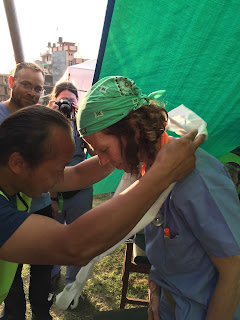
Jane volunteering in Nepal for
the devastating earthquake.
Jane also brings along a body tambura, a musical instrument developed in India to help alleviate the pain of patients in hospices that can’t afford pain medication. The instrument is placed on the person’s body. A study at St. Joseph’s Hospice for Dying Destitute/South India found the patient’s pain was cut in half after a relatively brief exposure and cut in half again the next day. Jane contacted the study’s author and found she could get a body tambura in Germany -- and had one made.

Jane’s interest in hospice care was sparked by the extremely different experiences of her father and mother at the end of life. Her father died in 2002 after a drawn-out battle with colon cancer. Jane recalls the hospice caregivers that came to her parents’ home lecturing her father about dying instead of listening to what he had to say. It broke him and all of the family, she says.

Ten years later, her mother came to live – and die – in Jane and her husband’s home. Her mother’s doctor, who was associated with the JSSA, made house calls and guided them through the hospice process with kindness and understanding – as well as enormous competence.

“After that experience, which I would characterize as a good – even healing – death, I became an evangelist for dying well,” Jane says. “The hospice team can make all the difference.”

Jane’s mother took her final breath within seconds of the earthquake that struck Maryland in August 2011. Jane’s son had just moved back from California and had the presence of mind to tell everyone to get to a doorway. A little while later, Jane and a few close women friends and family gently washed her mother’s body, all the while singing to her. As Jane sat by her mother, more friends began showing up with fresh flowers and herbs from their gardens and they lay them on and around her mother’s body. Some friends played music. After the sun set, it seemed the right time to bring her mother’s body out and as they emerged they found people with candles lining the path from house to street.

“That set the tone for my work in hospice, really,” Jane says.  “The possibility of a beautiful experience around death.”

Jane is one of 11 master trainers for Maryland Medical Orders for Life Sustaining Treatment. MOLST is a document that captures people’s end of life wishes. It goes way beyond its predecessor, the Do Not Resuscitate Order. It captures a patients’ wishes for a host of treatments, such as whether they want feeding tubes to be put in or to be transported to a hospital.  Jane and the other master trainers travel around the state educating health professionals, assisted living facilities, and the public in how to use the MOLST form.

Jane was named Montgomery County, Maryland’s
Volunteer of the Month earlier this Spring.

Jane, 57, has two masters degrees: one in social work and the other in government. She is the senior editor and writer at the U.S. Census Bureau. She lives in Bethesda, MD with her husband, Harry Lewis, and their two Yorkies, Callie and Cruiser. Her one adult son is engaged and Jane says she’s looking forward to grandchildren.

The third of four sisters, Jane says her parents chose to settle in Chevy Chase because they believed the Washington area was ground zero for civil and human rights volunteer work. Jane’s father, Dr. Earl Callen, a college physics professor and department chair at American University, started the American Civil Liberties Union of the National Capital Area. He was also on the Helsinki Watch Committee, whose mission was to monitor the former Soviet Union’s compliance with the Helsinki Accords, agreements to accept the post-World War II status quo in Europe.

Jane Callen
He regularly traveled back and forth to the Soviet Union to try to help “Refusniks,” -- scientists being persecuted and prevented from leaving. Dr. Callen frequently testified before Congress on this and other issues. He also was an outspoken anti-war activist and was frequently interviewed because, as a physicist, he could provide unique insight into nuclear war.

Jane’s mother, Anita Callen, was a stay-at-home mom and her quiet presence was the yin to her father’s yang, Jane says.

Jane recalls bouncing on her father’s shoulders amidst a sea of people as they headed toward the Lincoln Memorial, joining Martin Luther King Jr.’s March on Washington. It was her father’s 39th birthday – August 28, 1963. She knew they were among a minority of white people and that it was important to be there, to stand up for civil rights. It was one more lesson on the importance of taking action, a father-to-daughter message that has shaped her life.

“That was such an important lesson, taking action not for self-gain but for a greater good – without regard to personal risk,” Jane says. “Throughout his life, my father demonstrated the importance of always showing up.”
Monday, May 21, 2018

National Military Appreciation Month: Deployment Services

Written by: Carly Flumer, Volunteer


As May is National Military Appreciation Month, we will focus a series of blogs on our Red Cross Service to the Armed Forces program.

Imagine being away from your family for months, or even years, only to come back and not recognize anything. You feel lost in a place which was all too familiar not long ago. What kinds of thoughts would be running through your mind? What kinds of feelings would you want to express? The American Red Cross recognizes that coming home from deployment is one of the most difficult transitions one can make, and we look to make it easier by providing Reconnection Workshops to military members and their families.


These workshops are not only free and confidential, but they build and enhance lasting, positive relationships with those in the community. We realize that some may be scared to share their experiences, while others may be more outspoken; therefore, discussions can be held one-on-one or in groups, depending on preference. All members of every branch of the Armed Forces are welcome to participate, including those in the Reserve, National Guard, active duty members, veterans, and their families.

Adults may choose from five different topics, including:
  • Enhancing skills to develop clear communication
  • Recognizing and discussing stress, trauma, and other war-related concerns
  • Managing signs and symptoms of depression and learning when to seek help
  • Reconnecting with children by exploring family dynamics and deployment issues
  •  Exploring anger and other intense emotions in different situations

Children and teens may choose from two different topics, including:
  • The Roger That! Communication workshop, which focuses on developing and refining listening and communication skills
  • The Operation 10-4: Confident Coping workshop, which focuses on recognizing and enhancing strengths to help manage distressing situations